
Ask most people how 3D printing is used in defense and they’ll describe something small and metal. A titanium bracket, a fuel nozzle, a replacement part for an aging aircraft. That work matters, and it’s a big reason defense is now the largest revenue generator in additive manufacturing, ahead of aerospace, according to the 2026 Wohlers Report.
But something bigger is happening alongside it, and it’s literally bigger. Defense organisations are starting to print whole structures, full-size hulls and large tooling. The question is shifting from “can we print this part?” to “how much can we build, how fast, and how close to where it’s needed?”
That’s where large-format 3D printing comes in. Here’s why it’s getting so much attention, what it can do today, and where the hard problems still are.
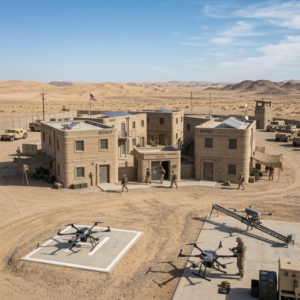
Image is AI generated for illustration purpose ONLY
Why defense cares: Time, not Novelty
Defense doesn’t adopt new technology because it’s exciting. It adopts it when it fixes a real constraint. With large-format printing, the constraint is time.
Conventional procurement and construction run on long lead times. A shelter needs formwork, crews and weeks of work. A specialised hull needs a mould, and the mould alone can take months. A worn-out part needs the original manufacturer, who may no longer make it.
Large-format printing goes after all three problems in the same way. You move the digital file instead of the physical object, then build close to where it’s needed. That makes supply chains shorter, less fragile and harder to disrupt. It’s also why industry analysts describe the push for large-format additive manufacturing as part of a wider demand for faster, more distributed production.
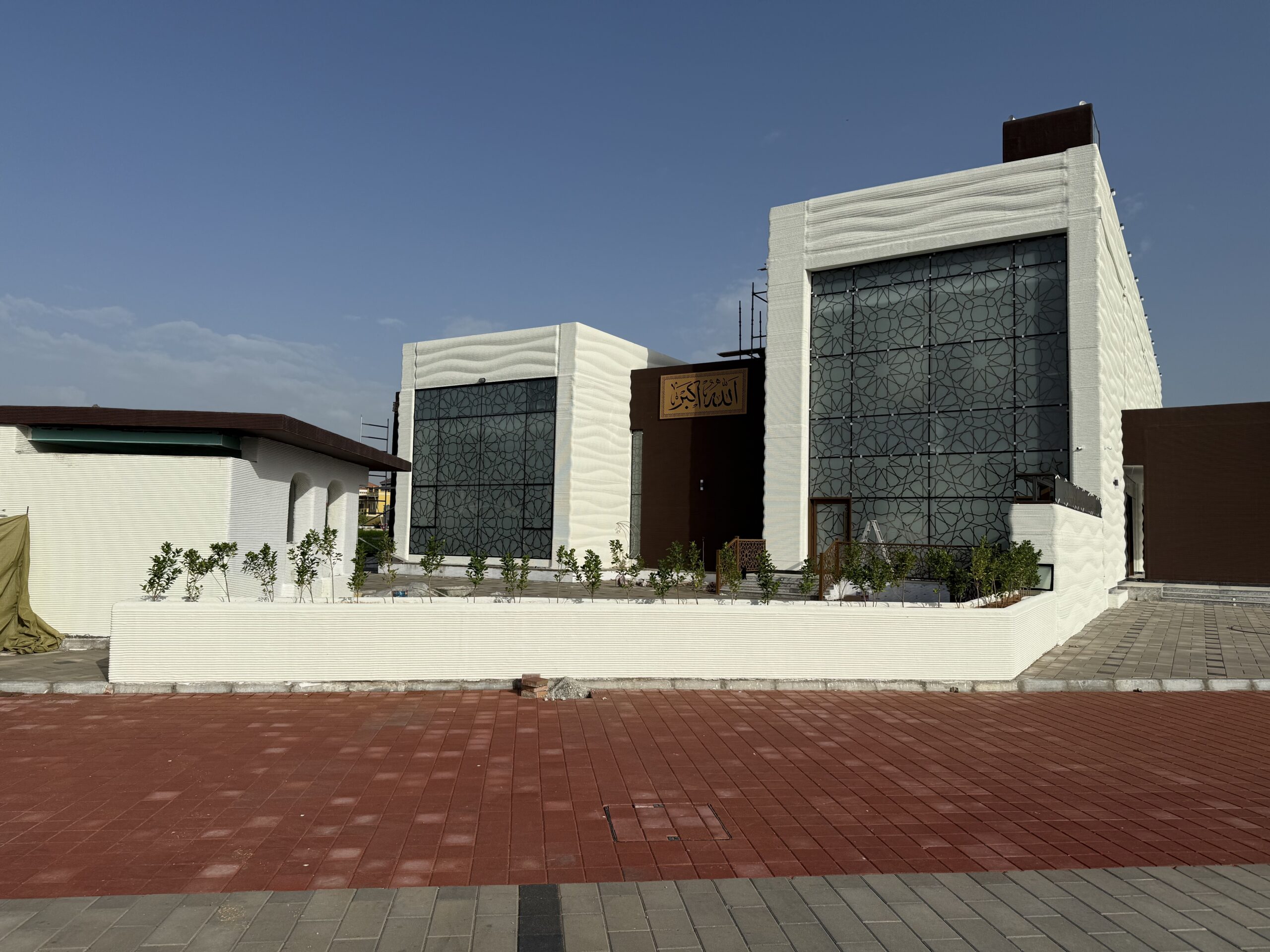
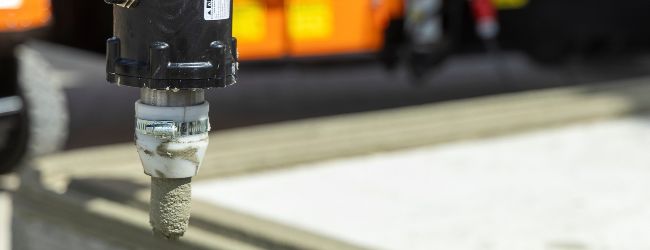
Concrete: Printing the base itself
The clearest proof so far comes from Fort Bliss, Texas. In July 2026, the US Army cut the ribbon on the first of ten 3D-printed barracks. Each building houses up to 56 soldiers. The US Army Corps of Engineers reports that the printing for all ten took 58 days. It also says the project ran four times faster than a typical build and came in 9% under initial estimates.
Those numbers matter less for what they say about one base than for what they suggest about many. Barracks are only the start. The same approach applies to:
- Hardened shelters and bunkers, where printed walls can be designed with thickness and internal geometry suited to protection
- Blast and perimeter barriers, printed on site instead of trucked in as heavy precast units
- Vehicle hides and storage, quick to raise and easy to adapt to the terrain
- Expeditionary buildings in remote locations, where flying in materials and crews is expensive
There’s a logistics win too. Earlier US Army research looked at printing structures with concrete made from locally available materials. That means less to ship to begin with.
Thermoplastic Composites: Big parts, no mould
Concrete builds the base. Reinforced thermoplastics build the things that move.
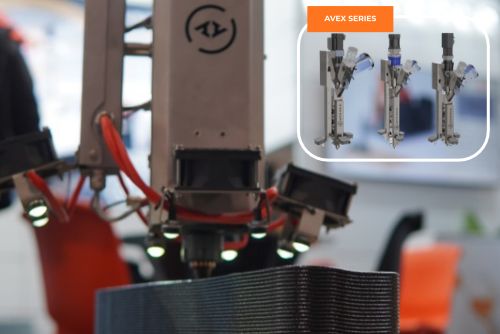
Large-format thermoplastic printing uses pellets of glass- or carbon-fibre-reinforced polymer. A robotic arm deposits the material layer by layer. The parts come out strong, light and resistant to corrosion, which matters a lot near salt water. And because there’s no mould, a design change is a file change, not months of retooling.
In defense, that opens up a few areas:
- Unmanned surface and underwater vehicles. Hulls and fairings for marine drones can be printed in one piece and redesigned between batches. We’ve printed a hull for an autonomous marine drone for a European marine robotics customer.
- Structural parts for vessels. We’ve printed a complete yacht hardtop, roof and supports together, in carbon-fibre-reinforced polycarbonate. The same thinking works for patrol craft and support boats.
- Enclosures and housings for sensors, communications gear and other field equipment.
- Moulds and tooling. Even when the final part is made another way, printing the tooling can save weeks.
Why mobility matters more than size
A huge printer stuck in a factory is still a factory. The real shift for defense is a printer that goes to the job.
That’s why mobile robotic systems are getting attention. A robotic arm on a crawler base can move around a site between prints. On a linear rail, it travels along one axis while printing. That means it can print structures much bigger than its own reach.
Our Mobile Rail comes in modular lengths of up to 12 m. The rail works as a synchronised seventh axis, so the robot and rail move as one. That lets it print seamless walls up to 12 m long, with about 4.5 m of effective height and accuracy of 1 mm over 10 m. For rougher ground, our tracked Crawler carries the same robot straight onto raw terrain, with no concrete pad needed.
For defense, that means fewer people, fewer truckloads and less time before a structure is ready to use.
What’s still hard
It would be easy to oversell this, so here are the real challenges.
Qualification takes time. Defense parts and structures have to meet strict standards, and printed parts need their own test data. The Fort Bliss barracks came after earlier pilot builds and years of testing. That’s normal, and it’s slow.
Materials need proving. A concrete mix or reinforced polymer has to perform in extreme heat, cold, salt and impact. Every new environment means more testing.
Skills are thin. Running a large-format printing cell takes people who understand robotics, materials and design for additive manufacturing. There aren’t enough of them yet.
Design has to change. You get the most from printing when the part is designed for it. A part redrawn for printing, with internal support structures and smarter geometry, beats a conventional design that has just been printed.
None of these is a dead end. They’re just the work that comes between a promising pilot and standard practice.
One platform, two materials
Most conversations treat concrete printing and composite printing as two separate worlds. In defense, they keep showing up in the same places: the base that needs shelters, the harbour that needs patrol craft, the depot that needs tooling.
That’s the gap we built AVENCO to fill. Our robotic systems print both concrete and reinforced thermoplastics. The same mobile rail carries either extruder, so one platform can print a protective wall one week and a drone hull the next.
The defense applications of 3D printing are getting bigger, in every sense. If you’re looking at large-format printing for structures, vessels or tooling, talk to our team about what’s possible today.