
Many 3D printed buildings are printed somewhere else. Wall panels come off a machine in a factory, get loaded onto trucks, and are lifted into place with a crane. It works, but it’s closer to prefabrication than to building.
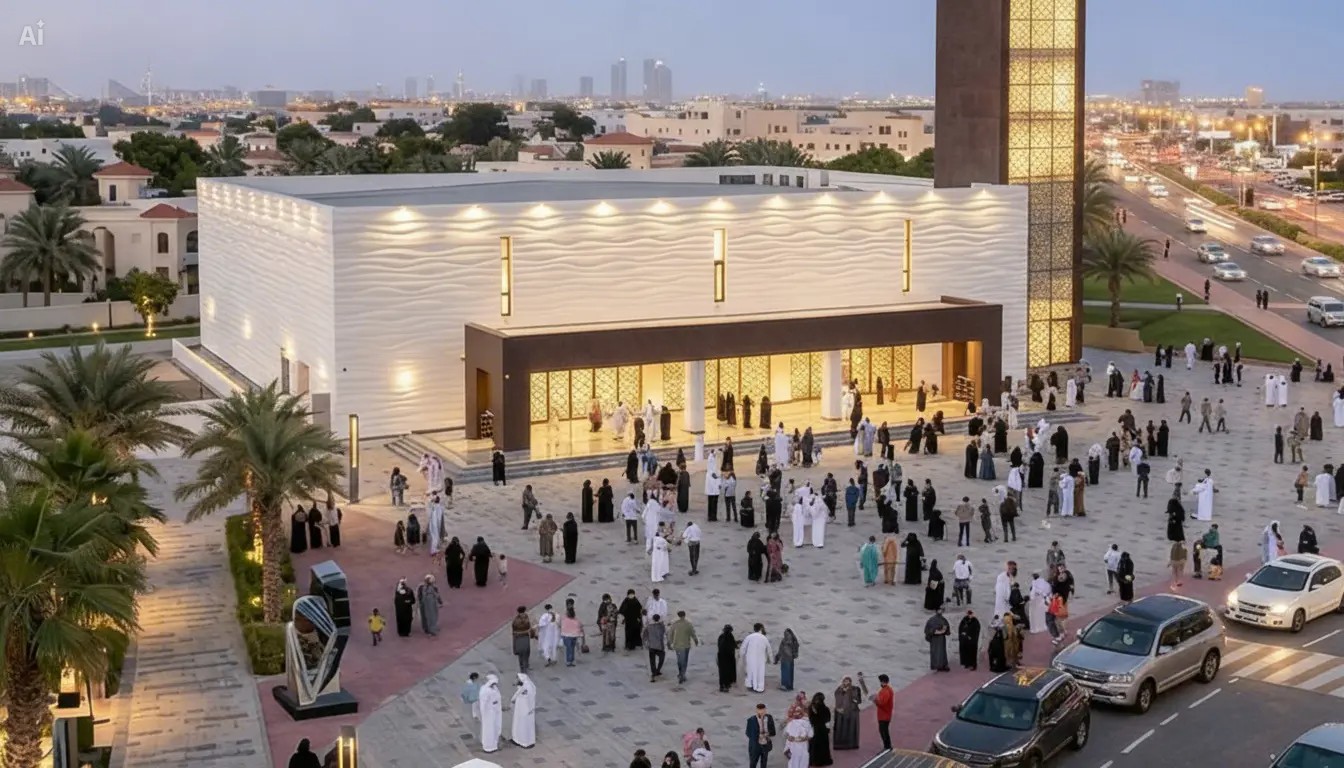
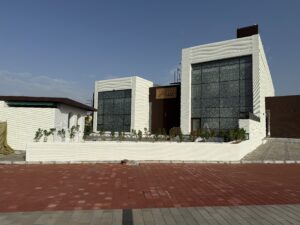
The Saddiq Abu Seedo Mosque in Dubai was done the other way round. The robots came to the site, and the mosque was printed where it stands. It is the first mosque in the world printed on site with robotic arms, and it was delivered by Avenco in under 10 months.
This article looks at how it was built, what the numbers mean, and why this project matters for anyone thinking about 3D printing in construction.
The Project at a Glance
| Project | Saddiq Abu Seedo Mosque, Dubai, UAE |
| Scope | 1,400 sqm settlement area, including the Imam house |
| Method | On-site robotic 3D concrete printing |
| Robotic systems | Robot on crawler + robot on slider (linear rail) |
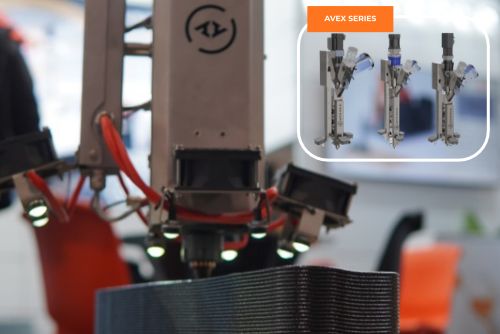
| Extruder | 2K concrete extruder |
| Max extrusion capacity | 35 litres per minute |
| Min layer height | 10 mm |
| Max travel speed | 15,000 mm/min |
| Delivery time | Under 10 months |
Why Print On Site At All?
Printing in a factory is easier to control. The floor is level, the weather doesn’t matter, and the machine never moves. So why would anyone take a robot out into a Dubai construction site?
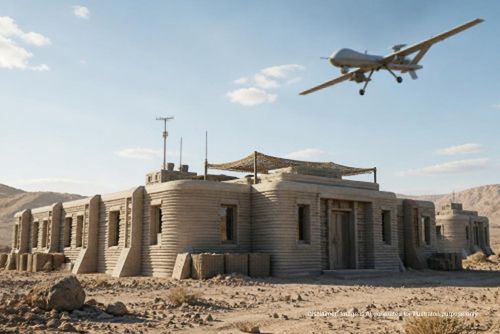
Because the building ends up better connected to its ground. When walls are printed in place, there are no panel joints to seal, no heavy elements to transport, and no crane schedule to plan around. The design also isn’t limited by what fits on a truck. If the wall needs to curve, twist or change thickness along its length, the robot simply follows the path.
The catch is that on-site printing asks a lot of the equipment. The system has to move around the site, stay accurate on uneven ground, and keep printing through heat, dust and long working days. That’s where the choice of robots made the difference.
Two robots, two jobs
Avenco used two different robotic systems on the mosque, working side by side.
The robot on crawler is a robotic arm mounted on a tracked, mobile base. It can drive across the site and set up wherever it’s needed. Think of it as the flexible one. It handles areas that a fixed setup can’t easily reach and moves on once a section is done.
The robot on slider is a robotic arm that travels along a linear rail. Instead of repositioning the robot for every section, the arm glides along the rail and keeps printing. It suits long, continuous wall runs where consistency matters most.
Using both meant the team could match the machine to the geometry instead of forcing one machine to do everything. It’s also what made the mosque’s timeline possible. Two systems on site means two areas in progress at once.
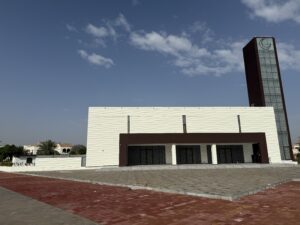
Walls Designed in Three Dimensions
The mosque’s walls weren’t drawn as flat surfaces and then printed. They were designed as three-dimensional forms from the start, with depth, texture and movement built into the geometry.
That kind of wall is hard and expensive to build with formwork. Every curve needs its own mould, and every mould is made, used and thrown away. With robotic printing, the complexity lives in the print path, not in timber and steel.
To print those forms properly, Avenco used a 2K concrete extruder. “2K” means two components. An accelerator is added to the concrete right at the print head, so the material stays workable while it’s pumped and then starts to set as soon as it’s placed. Each layer firms up fast enough to carry the next one, which is what lets a printed wall rise cleanly, hold its shape on curves, and keep the design intact.
The Numbers, in Plain Terms
Specs on their own can feel abstract, so here’s what each one means on a real site.
35 litres per minute maximum extrusion. At full output, that’s up to 2,100 litres of concrete an hour coming out of the nozzle. In practice, the flow is tuned to the wall section and the speed of the robot, but the headroom matters. It means the extruder isn’t the bottleneck.
10 mm minimum layer height. Thinner layers give a finer finish and more control over detail. For a mosque, where the look of the walls is part of the architecture, being able to go down to 10 mm matters.
15,000 mm per minute maximum travel speed. That’s 15 metres a minute. Fast travel means less time moving between print sections and more time actually printing.
An optimised, printable process. None of the above helps if the design can’t be printed well. Part of the work on this project was making sure the design, the print paths and the material all fit together, so the robots were printing what they’re good at printing and the process ran smoothly from layer to layer.
Under 10 Months, Start to Finish
The mosque was completed in less than 10 months.
For a religious building with custom three-dimensional walls and an Imam house on a 1,400 sqm settlement area, that’s a strong result. Much of the time saved comes from what the project didn’t need. No formwork to build and strip for the printed walls. No factory production running ahead of site work. No waiting on transport and lifting.
What This Means for Construction in the UAE
Dubai has been open about its ambitions here. The emirate’s 3D Printing Strategy sets a goal of ensuring that 25% of all its future buildings are 3D printed. Projects like the Saddiq Abu Seedo Mosque show that this isn’t only about simple boxes or pilot structures. A community building with real architectural character can be printed in place, by robots, on a normal construction timeline.
For developers and contractors, the takeaway is practical. On-site robotic printing is not a replacement for everything on a building site. It’s a way to automate one of the slowest and most labour-heavy parts of the job, the walls, while opening up design options that would be too costly to build by hand.
Frequently Asked Questions
What is the Saddiq Abu Seedo Mosque?
It is a mosque in Dubai, UAE, printed on site using robotic 3D concrete printing by Avenco. The project covers a 1,400 sqm settlement area and includes the Imam house.
Is it the world’s first 3D printed mosque?
It is the first mosque in the world printed on site with robotic arms. Its walls were printed in place rather than produced in a factory and shipped in.
What robots were used to print the mosque?
Two systems: a robotic arm on a mobile crawler base and a robotic arm on a slider (linear rail), both fitted with a 2K concrete extruder.
What is a 2K concrete extruder?
A two-component extruder that adds an accelerator to the concrete at the print head. This lets each layer set quickly so the wall can rise steadily and hold complex shapes.
How long did it take to build?
Under 10 months
Can this technology be used for other buildings?
Yes. Avenco’s on-site robotic concrete printing systems can be used for buildings, walls, architectural elements and urban furniture.
Build with Avenco
Avenco designs and delivers robotic 3D printing systems for construction, from mobile crawler robots to linear rail platforms and 2K concrete extruders. If you’re planning a project and want to know whether on-site printing fits, contact our team.