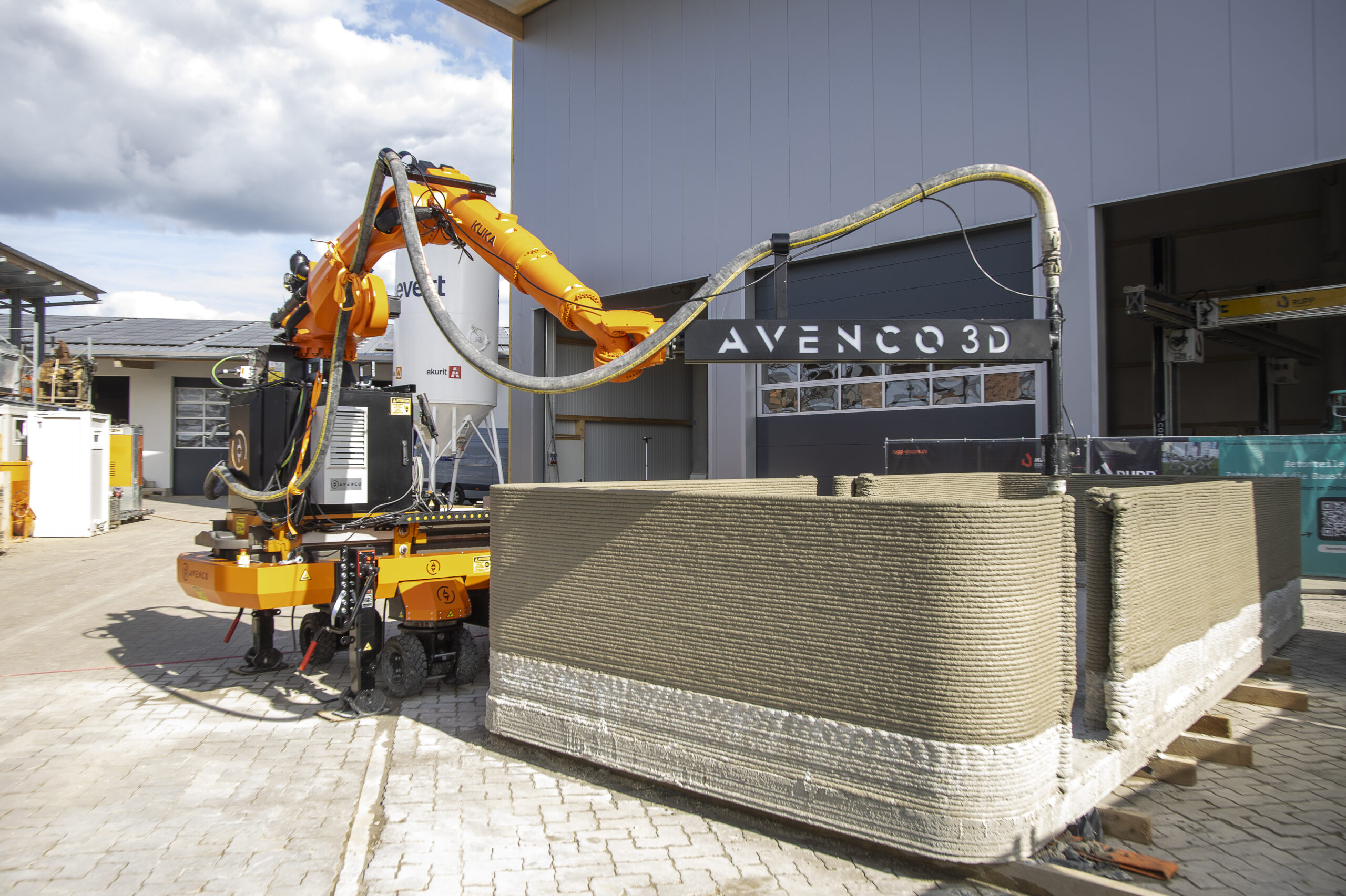

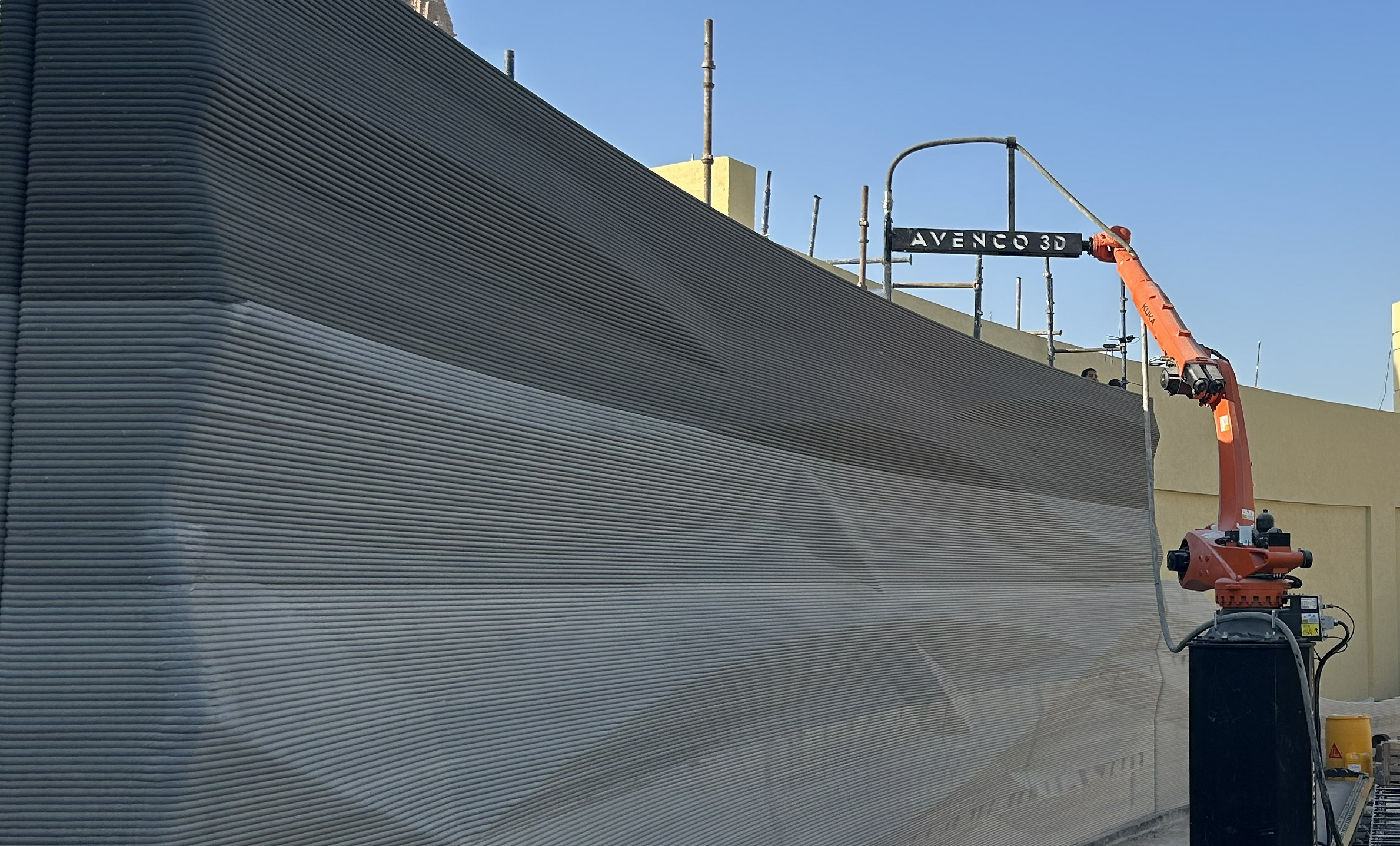
Every few months the same video circulates. A robot tracks along a wall path, concrete stacks up layer by layer, and the caption promises a house printed in 24 hours.
The comments split immediately. One group sees the future of construction. The other points out that we have been watching versions of this clip for a decade while conventional building carries on unchanged.
Both groups are answering the wrong question.
Whether concrete can be printed was settled years ago. It can. The open question is narrower and far more useful to anyone holding a budget: which parts of a build are actually worth automating, and can a contractor put a number on the benefit?
This article separates what concrete 3D printing genuinely does from what it was oversold as doing and sets out how to judge whether a system earns its place on a project.
Why “A House in 24 Hours” Set the Wrong Expectation
It was a brilliant headline. It was also a promise the industry could never really keep.
Printing walls is not delivering a home. Foundations, openings, reinforcement, MEP, waterproofing, insulation, roofing and finishes all still happen at conventional speed. When a printer completes the wall envelope in a day, the rest of the programme barely moves.
So the 24-hour claim set an expectation that every real project then failed to meet. That gap is where most of today’s scepticism comes from. The industry sold the headline and inherited the disappointment.
The more defensible promise was always narrower, and commercially it is the better one: automate the specific processes where robotics produce a measurable gain, and leave the rest of the build alone.
What Concrete 3D Printing Actually Automates
Three processes account for most of the value in 3DCP today. Each is measurable, and each can be assessed before a machine is purchased.
Eliminating Custom Formwork
On curved, tapered or one-off geometry, formwork is frequently the largest single cost line on the wall package. It is bespoke, labour-heavy, used once, then skipped.
Non-formwork construction removes that line item outright. Changing the geometry means changing a toolpath, not commissioning new moulds which is the point at which printed geometry stops being a novelty and becomes an economic argument.
This is also why printed construction rarely competes well against simple rectilinear walls. A straight block wall is cheap to build conventionally. The advantage appears where conventional methods get expensive, and that is almost always where formwork gets complicated.
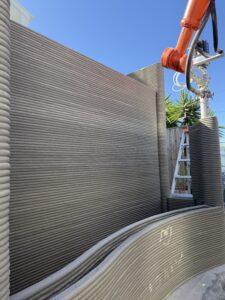
Photo Courtesy of xBuild
Cutting Layer Cycle Times With 2K Concrete Extruders
A printer is only as fast as the material allows.
Single-component mixes force long waits between layers while the previous course gains enough strength to carry the next. Print too soon and the structure deforms; wait too long and the bond between layers suffers. Either way the programme is at the mercy of ambient conditions.
2K concrete extruders change that relationship. By dosing accelerator at the nozzle rather than pre-mixing it, the material can be pumped in a workable state and stiffen immediately after deposition. Layer times drop under 10 seconds, and a structure can rise continuously rather than in stages.
Buildability stops being the constraint on the schedule, which is what makes printing viable on a commercial programme rather than a demonstration.
Bringing the Printer to the Work: Mobile Crawlers and Linear Rails
A system that has to be craned in and calibrated over several days will lose to a crew that simply shows up.
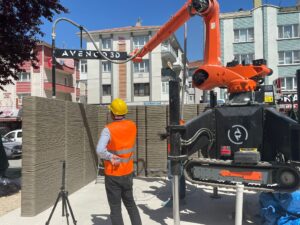
Mobile robotic 3D printing changes the arithmetic. Mobile crawler platforms walk the machine to the work and print in place, which matters on constrained sites and on structures larger than any fixed gantry envelope. Linear rail systems cover long, repetitive runs — wall panels, precast beds, series production — from a single cell with one robot arm.
Setup time is not a footnote in construction. It is often the difference between a printer that runs several jobs a year and one that runs two.
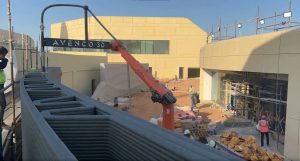
BAPS Hindu Temple, Abu Dhabi
How to Calculate 3D Concrete Printer ROI
The useful question is not “can we print a building.” It is “which part of this scope is worth automating, and what does it return?”
3D concrete printer ROI comes from unglamorous places:
Formwork never fabricated. On geometry-heavy projects this is often the single largest saving, and it is knowable from the drawings before any machine arrives.
Labour hours not spent on repetitive wall production. Particularly where skilled trades are scarce, expensive or difficult to mobilise to site.
Material waste not carted off site. Additive deposition places material where the design requires it rather than trimming back from a poured mass.
Machine utilisation across the year. A printer used on several jobs amortises very differently from one parked between showcase projects. This is the number most often left out of early business cases, and the one that moves the result most.
Every one of these can be counted before a system is bought, which is exactly how any other piece of capital equipment gets approved. A business case built on those four lines will survive scrutiny. One built on a 24-hour headline will not.
What Still Slows Adoption
An honest assessment has to include what remains unresolved.
Reinforcement is the most significant. Concrete performs well in compression but needs reinforcement wherever tensile forces matter. Integrating reinforcement strategies with continuous robotic deposition without losing the productivity that justified printing in the first place is still an active area of development across the industry.
Approvals remain project-specific in most markets. Printed structures are frequently assessed as exceptional cases rather than through established routes, which adds time and cost that a conventional build does not carry.
Geometry has practical limits. Unsupported overhangs, horizontal spans and certain complex forms still require design adjustment, temporary support or hybrid methods.
None of this makes printing unviable. It does mean the technology belongs on scopes where its advantages are clear, rather than being forced onto projects it was never suited to.
Where the Technology Is Proving Itself
The Gulf is a useful region to watch.
The UAE has pushed printed construction into real projects for years, and real projects generate what demonstrations cannot: inspections, code conversations, operator hours, contractor feedback and a running record of what breaks and why.
The first project on any new system is rarely the optimised one. The tenth is better. That learning curve, not another market forecast, is what will decide whether this technology settles into the industry or stays on the exhibition floor.
Policy support does not prove commercial viability. It does create enough repetition for the economics to improve, which is how most industrial technologies have matured.
Where AVENCO Fits
We build the hardware layer of that answer: concrete and thermoplastic extruders, mobile crawler platforms and linear rail systems, delivered as complete printing solutions rather than a robot with an attachment bolted on.
We do not sell a house in 24 hours. We sell formwork you do not have to build, layer cycles under 10 seconds, and a printing cell that travels to the site instead of the other way round.
Concrete 3D printing does not need to replace conventional construction to matter. It needs to earn a place on specific scopes, repeatedly, with numbers a project manager recognises.
We already know concrete can be printed. The work now is proving where printing pays.